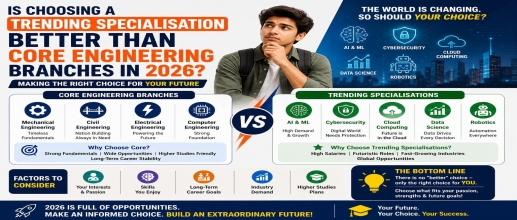
Admissions in 2026 for engineering stream will be never be seen as 2016, previously ‘CSE’ ‘ECE’ and ‘Mechanical’ branch were the most preferred choice of aspiring engineers. But, with introduction of more specialized branches like:
There has been confusion among students who want to pursue engineering studies Should go with trend or choose a core branch AIML will land me in a better position or just CSE?
So, here’s a complete breakdown covering all the topics – what’s changing technologically, which specialization will be useful, when to go for core branch and how to select top colleges and also decide for professional journey.
Basically, it should be both strategic and deeply personal. This means students need to pick their branch choice which will be in- demand for at least 15yrs not just for the sake of trend and placement.
There have been increased demand in branches after 2020
|
CORE BRANCHES |
SPECIALIZATION |
|
It’s the roots i.e fundamental knowledge of engineering which will always remain same. Unlikely to disappear. |
These are developing, evolving and may seems volatile. |
|
Industries running today will need them in future too. |
Technological disruption can bring shift in the fields. |
|
The scope is enormous and filled with perennial opportunities in sectors, industries, power and infrastructure. |
The scope is growing in IT, Finance, AI and Tech start-ups. |
|
The growth in career is steady and sustainable without burnout |
It’s unpredictable, they offer swift advancement in career and high salary. |
|
Risk factor is low. The industries are solid and mature. |
Risk is high Continuous Upskilling and adaptability is required as it’s evolving. |
|
Works on principles to solve any practical and complex problems to make new innovations. |
It’s all about innovation, pushing out old tech and create new ones. |
This is the biggest confusion of students “Should they opt for well established CSE or fast evolving AI and ML
Core CSE – Means Flexibility
NOTE:
|
B. tech CSE if students want flexibility, long-term stability. |
B. tech AI & ML are confident about AI driven careers. |
|
Not sure about specialization |
Is interested in maths, logic and analytics |
|
Want to explore other tech domains. |
Has a thing for new technologies. |
|
Tier 2 or 3 private colleges – Better for Core CSE. |
IIT/NIT/IIT-H/BITS – Better for CSE – AI& ML |
VLSI, the new catch after AI, but should students go for it.
|
CORE ECE |
ECE- VLSI |
EMBEDDED SYSTEM |
|
This branch can be aspiring engineers safe based. |
This one is new and developing, requires deep passion for electronics. |
This offers both software and hardware accessibility. |
|
Curriculum focus is broad, students study analog circuits, digital signals and systems (5G/6G), EMFT and introduction of VLSI. |
Main curriculum starts from 3rd semester includes Cadence/Synopsys tools, ASIC design, FPGA testing, integrated circuits using hardware description languages and physical designs. |
Programming language of C/C++ with micro controllers, sensors and firmware development, RTOS are part of curriculum. |
|
Job roles best suited in telecommunication, defence, research, consumer electronics and general hardware maintenance and government jobs PSUs. |
It offers high- end roles in companies like Intel, Qualcomm which makes semiconductor, Design Engineer, Verification Engineer, Layout Engineer and Physical Designs Engineer. |
Job roles are offered both in IT sector and hardware industry such as Embedded Software Developer, Firmware Engineer, System Engineer, IOT Developer |
|
Demand is Moderate to High. |
High due to booming in semicon. |
High demand. |
|
Average salary 4-12 LPA. |
Average salary 6-12 LPA entry to mid level. |
Average salary 5-10 LPA entry to mid level. |
|
Opportunities in global hiring is moderate level |
Global opportunities are very high with long term growth option. |
Opportunities in global market is high with steady growth with potential in IOT, AIOT. |
Students nowadays are not big fan of Mechanical branch, but this is an evergreen branch of Engineering.
|
CORE MECHANICAL |
MECH ROBOTICS/AUTOMATION |
|
Evergreen branch |
New and Emerging and Trending |
|
Curriculum contains thermos fluids, machine design, manufacturing, materials, heat transfer. |
Along with mechanical fundamentals it also starts ROS, control systems actuators, PLC, in 2nd year Mechatronics. |
|
Focus is on physical hardware mechanics and energy system. |
Intelligent control, software and autonomous behaviour. |
|
Career in Automotive, Aerospace, HVAC and Construction. |
Tech, Manufacturing tech, AI Research, Warehousing. |
|
Entry -level positions typically start at ?3-5LPA while highest salary is upto ?10LPA. |
Fresher salary upto ?4-12.45 LPA and highest salary for top talent 15LPA. |
You can get placement advantage by choosing a specialisation branch if you choose wisely seeing few important factors:
Core engineering branches (civil mechanical and electrical) will offer superior career security when graduates pursue public sector rules (PSUS) get hands on field experiences, work in industrial sector or focus on specialisation.
Career stability is offered highly in renewable energy, defence and infrastructure Plus it also doesn't get affected by recession or technology shift.
The college selection should be wise: College rank > 10K in JEE or You choose the suitable private college.
|
Criteria |
Core Branch |
Specialised Branch |
2026 |
|
Industry coverage |
8-12 sectors: IT, core, PSU govt. R&D |
2-4 sectors only niche |
Core |
|
College |
Any good college will work |
Top tier colleges with labs and good faculty. |
Core |
|
Skill obsolescence risk |
Low The fundamental knowledge will be there for at least 40 years |
High Every thing you learn, tools you use gets upgraded within 3 years. |
Core |
|
GATE/ PSU/ UPSC |
Same syllabus |
About 50-70% of syllabus match. |
Core |
|
Entry level salary |
3.5 – 6 Lakh per annum Mass hiring. |
3 – 4 Lakh per annum Low placement. |
Core |
|
Highest salary |
6 – 30 Lakh per annum on experience and skill. |
8 – 50 Lakh per annum Only for top 10% gets highest packages. |
Tie |
|
Pivot to 2030 |
Easy to switch, just upgraded 1 skill. |
Hard You need to upskill in 2years. |
Core |
|
AI automation |
EEE/CIVIL/MECHANICAL/ECE Low |
CSE AI/ Data Medium |
Core |
Note: VIT, SRM, MIT- MANIPAL, BITS PILANI, KIIT, THAPAR. These has NBA/ ABET + real industry MOUs and gives placement at its best.
FAQs: