May 04, 2026 by Admin
Choosing an engineering branch in 2026 is like “A high risk, irreversible commitment”. Around 2015-2021 the first choice of students was CBSE core as it got them secured jobs and higher packages. And students who looked for career stability choose either of Mechanical/Civil/ECE.
But after introduction of AI, IT sectors job has been cut to 60%. Entry-level jobs of coding, testing and drafting jobs have been automated by AI. This has created job instability and panic among engineers.
However, AI is eating up bits and bytes but the industries working with atoms are on the flourish for India with a budget of INR 1440 lakh crores in power grid, EVs, semiconductor, construction, defence, data centres, metros, which doesn’t require programming language but real engineers to work.
So, here is the complete blog that guides you with data not noise:
- Why Core EEE, Civil, Mech, and ECE have the lowest automation risk
- How CSE survives if you go beyond plain coding
- When a specialization helps vs when it hurts
- Salary reality for 2024-2026 and what to expect by 2035
- A no-nonsense guide for Tier-2/3 colleges
If you’re a student or parent deciding in 2026, read this before you lock your JOSAA choice. The goal isn’t to chase the hottest branch today. It’s to pick one that gives career growth and stability.
Here is the engineering branch options that has the lowest risk in the next 10 years
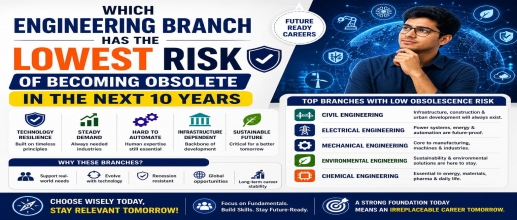
Seeing the scenario, the lowest risk branches for the next 10 years are
EEE – Electronics and Electrical Engineering.
CE – Civil Engineering.
ME – Mechanical Engineering.
ECE – Electronics and Communication Engineering.
Why students now ask which branch will survive
- AI impact on jobs
Most of the jobs (coding, drafting, testing) at the entry level, which were earlier jobs of fresher (CSE & IT) graduates, are now done by AI tools. Just one skilled engineer and AI tools to do the complete task.
However, the branches of physical importance are safe
- Changing Hiring Patterns
Around 2015-2021, companies like TCS/Infosys did mass hiring; even candidates from B.tech Civil and Mechanical were hired for coding jobs.
But since 2023-2026, the trends have changed; professionals with skills are preferred. Intake in IT company has been cut to 60%. Campus placement is just the shortlisting of candidates. They have to face LeetCode and GitHub checks before the actual interview.
- Long-term Branch Value
When thinking about 10 years from now, students check for
?A.I. antipathy – The branches like EEE, Civil, Mechanical, and Chemical are harder to automate as they work with atoms, not bits and bytes.
Government-Catalyst- Great opportunities with branches like EEE, ECE, Mechanical, and Civil. About 30 lakh crore in renewable energy, EVs, semiconductors, fabrication, defence, and smart cities have been planned by government bodies till 2040.
Agility – Core branches will give better adaptability, wherein CSE without specialization can be risky if coding overfills.
|
Safest Branches
|
Why
|
Average salary
|
|
EEE
|
Energy +EV +Railways +Data centres
|
4-12 LPA core
8-20LPA EV
|
|
Civil
|
Infra+ Highways+ Metros+ Airports+Smart Cities till 2047
|
4-9 LPA increases with experience
|
|
Mechanical+ Robotics
|
Manufacturing+ Automation
|
6-15 LPA
|
|
ECE
|
Semiconductor+ 5G/6G, JOT, Defence
|
5-25 LPA
|
Highest Risk Branches – CSE/IT without any specialization. To survive, IT engineers will have to upskill themselves every 2 years with the latest trends and technologies.
What Makes an Engineering Branch Future-Proof?
While students are choosing the B.Tech branch in 2026” it should not be about trends".
Rather, they need to focus on surviving at least 4 cycles of technological advancement across their long career. Here are a few points to help them make a decision:
- Adaptability – Can you shift when tech shifts?
There are many core branches that are ready to pivot, as their fundamental knowledge base is transferable, for instance:
- ECE - Telecom - VLSI -IoT - AI chips
- EEE - Power grids - Solar - EV charging Data center power
- Mechanical - Robotics - EV charging - 3-D printing.
- Multi-sector use?
Do you get hired in any sector depending on your branch?
If you are only with IT knowledge, that’s risky, as your options could shrink.
Plain web developer = IT sector + start-ups only.
Multiple option sectors are recession safe.
Other core branches give you safer options after AI introduction and development
Technological Alignment – Are those backed up by government funds for 10-20 years?
See the money tailwind, talking about India only
- About INR 30,000,000 crore is to be used by 2030 in every energy transition: solar, wind, and green hydrogen.
- A total budget of 10 billion dollars is to be invested in semiconductors, fabrication facilities, OSAT, and displays; all will require core branches' domination for at least 15 years.
- A minimum investment of INR 140 L crore is expected in the National Infrastructure Pipeline till 2047. Branches like civil, mechanical, and EEE are in demand.
- By 2030 expected sales of electric vehicles are to be increased up to 30%.
- ECE / Mechanical / Aerospace / EEE will contribute to a rise in 10% of the budget of defence and space.
NOTE: So, students with a core branch will have better job options
CSE and Its Ability to Evolve with New Technologies
No other branch has invented itself this fast, like CSE, for 40 years of its introduction with
- Mainframe
- PC
- Internet
- Mobile
- Cloud AI
And also in the IT market, you can always see a need for proficient software engineers.
The Catch in the 2026 AI Era
After AI advancements many technical changes have started, like the boilerplate code—about 50% of it is written by AI; CRUD apps, unit tests, and basic debugging are handled by Copilot, Devin, and GPT-5.
- AI introduction has been bad for entry-level hiring in IT services; it has been cut to 50 to 60%.
- Since 2022, websites are being developed with React AI.
- Manual quality check and testing are now automated.
How does CSE stay future-proof?
CSE is not dying, but average CSE is." As seen in 2025, more jobs were in digital engineering and product roles, not the IT sector. And clearing Leet Code Hard or building a system is important, or the risk is real.
- Deeper knowledge, not broader—compilers, operating systems, databases, networks, security, and distributed system automation are hard.
- AI/ML systems - Only using the OpenAI API, think beyond like using MLOps, training infra, and model deployment at scale.
- Cyber security + cloud computing—All the companies now are tech zero trust + AWS / Azure / GCP = constant.
- Domain - Choose Fintech, health tech, block chain, infra, and robotics software.
Why ECE still remains relevant in hardware-driven growth.
There was a setback in hardware when software came in 2010 – 2020. But again, hardware is flourishing.
- ECE booming
Semiconductors, chip designs, VLSI, all come under the ECE branch.
India’s dollar 10B ISM plan targets 5 fabrication + 100 SAT units by 2030. The development of a single fab needs around 3000-plus engineers.
The hardware can’t be outsourced to the cloud; this was proved when the chip shortage was seen worldwide and resulted in Taiwan/China/US dominance ending. India has become its new address with a 10% share.
- AI Needs Hardware
More demand in 5G/6G for RF engineers, antenna design, signal processing, IoT + defence—Every software working runs on ECE hardware, whether it's sensors, drones, satellites, etc.
AI has increased the demand of both EE and EEE, ever thanks to CPUs, NPUs, and data centres; power depends on it.
- Pivot options
The ECE engineers can shift their field to software easily, but it can be hard vice versa. ECE graduates learn about circuits, math, and C / Python languages. But CSE graduates cannot design an RF amplifier with prior knowledge.
AI & ML: Fast Growth but Rapid Skill Replacement Risk
Why everybody is moving into AI & ML?
- It is in demand in every sector; all need AI teams: finance, health, retail, and manufacturing.
- Pay scale is high for freshers with AI & ML specialization.
- The highest salary for IIT/NIIT has been 18.15 lakh per annum.
- even in Tier 2 colleges – 10-20 lakh per annum.
- AI is hot; hyped, all top sectors are using AI.
How to stay safe in AI & ML times
- Choose the Maths+ system—as we know, tools tend to change with the math curriculum (linear algebra, probability), but systems (optimization, distributed training) don't change.
- MLOPs + Infra – Companies pay for scale, not regular notebooks. Data, pipelines, CPU clusters, latency, cost optimization.
- AI + X—There needs to be a dip in domain to beat generic ML.
- AI + Robotics, AI + Chips, AI + Biology, AI + Finance.
- Research: - Be the lead; don’t be a chaser. If you research PhD work, publish it.
- Keep learning new skills; you will be safe in an AI/ML scenario.
- Mechanical engineering is an automated industrial world.
- The myth: Mechanical engineers will be replaced by robots.
- Reality: Robots need to be designed, built, and maintained, which is done by mechanical engineers.
What's breaking down in mechanical engineering?
- Drafting on AutoCAD took 8 hours per day now AI does the work just in 10 minutes
- Automation of CNC machine operations, as it has to be done manually.
- Maintenance has become predictive and faster.
EV Revolution by 2030:
- India has a need of about 200,000 EV engineers; there will be a need for battery packs, thermal management, motors, and chassis.
- Robotics and automation- Industries and factories who have added Robotics arm requires Mechanical + Mechatronics for kinematics, dynamics and materials.
- HVAC for AI data centres burns up to 40% power on cooling. So, there is immense demand for liquid cooling immersion systems for CPU farms, which are designed by mechanical engineers.
- Aerospace/Defence - With the Indian government's Atmanirbhar push, more jobs have come into existence.
- Layered Manufacturing - New mechanical fields emerged for the making of aerospace components and 3D printing of metal parts.
Skill requirements for 2030
- CAD + AI generative design, robotics, Python, EV, mechatronics, FEA, and CFD.
- Salary for core mechanical: 4 to 10 lakh per annum
- Mechanical + EV + Robotics is 8-25 lakh per annum.
- Mechanical + Coding is 15-50 lakh per annum.
Which branch faces the lowest Automation- Risk comparison?
|
Branch
|
Automation Risk
|
Why
|
10-year stability
|
Average salary
|
|
EEE
|
Lowest
|
Field regulations and heavy physical grids
|
EV, solar data centres
|
4-12 LPA core; 8-20 LPA for EV
|
|
CIVIL
|
Low
|
AI can’t do site execution, soil, or safety
|
India creates opportunities till 2047.
|
3-10 LPA
|
|
MECH+ROBOTICS
|
Low-medium
|
Builders are required in factories
|
Should add EV skills/mechatronics
|
4-15 LPA
|
|
ECE - VLSI
|
Low-medium
|
|
Semiconductors, 5G/6G chips, and defence are booming
|
6-25 LPA
|
|
CHEMICAL
|
Medium
|
|
Pharma, batteries, and green hydrogen are growing
|
3-12 LPA
|
|
CSE-AI/Cloud
|
Medium
|
|
Upskilling after 2 years will be needed to maintain a high pay scale
|
6-50 LPA
|
|
CSE/IT Plain
|
High
|
Mass Hiring
|
now being reduced due to entry-level job has done by automation
|
3-7 LPA
|
Which branch can adapt best to new technologies?
ECE with EEE and even MECH
- Graduates of ECE have the following curriculum: circuit + signals + programming + math.
- VLSI, IoT, telecom, AI hardware, robotics, EV power, and electronics.
- CSE graduates then adapt only within software but not into ECE.
- Mechanical and EE can work in physical environments.
Which are the best branches for long-term career stability in India?
- EEE: This one is a growing and future-proof branch till 2047 with government, private, and PSU jobs.
- As power is needed everywhere in our homes, EVs, factories, and data centres.
- Civil - Its recession-proof branch, as there will always be development and construction of roads, metro, water, and urban infrastructure. The future budget is 143 lakh crores till 2047.
- ECE - India will be the top supplier of chips for semiconductors, defence, and 5G.
- Mechanical with EV / Robotics – Mechanical will be hit, but plain mechanical will be stable, still a win-win situation.